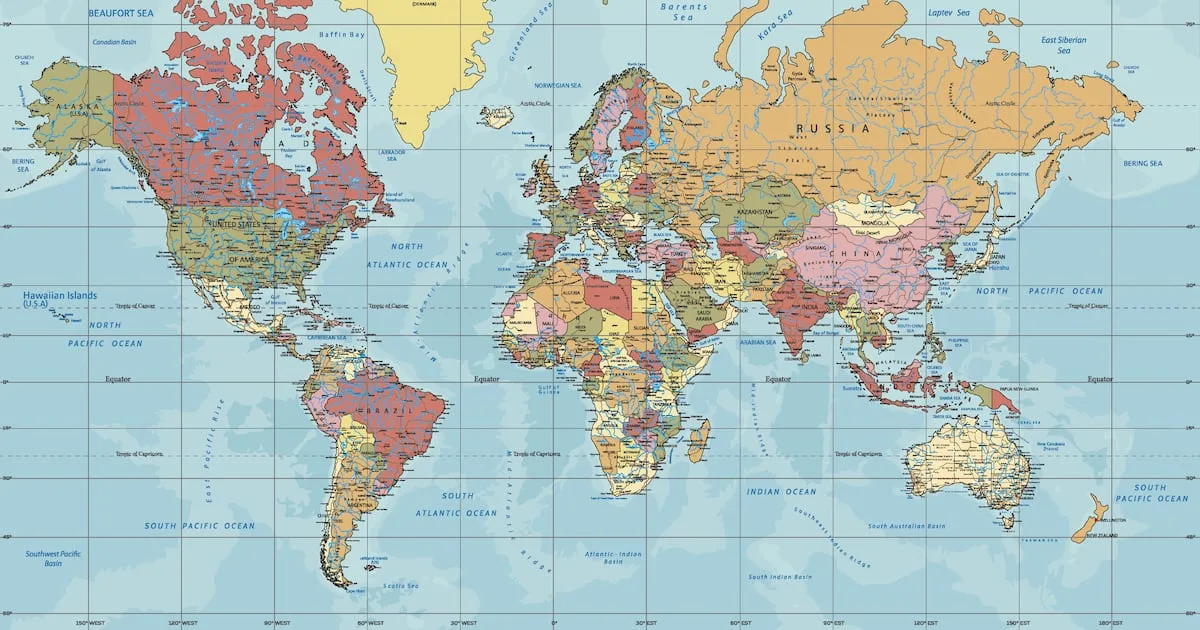
In today's world, geographical maps are considered a key tool in education. But the question arises: is using one type of map sufficient for teaching geography? Should children only be familiar with Mercator maps? The answer to this question is simply "no." In fact, using diverse maps can help children gain a better understanding of geography and the world.
Diversity of Maps and Its Importance
Mercator maps are recognized as one of the most popular maps due to their specific features, including angle preservation. However, these maps significantly distort the size of continents. For example, Greenland appears dramatically larger on the Mercator map than it actually is. In contrast, equal-area maps, which display the sizes of continents more accurately, help children develop a more realistic perception of geography and the geographical distribution of the Earth.
For this reason, geography education should incorporate more diversity. Children should be introduced to various maps and understand the differences between them. Using multiple types of maps can help them gain a broader perspective of the world and its different places. This diversity not only aids in better understanding of geography but also enhances children's critical and analytical thinking skills.
Consequences of Lack of Diversity in Map Education
If geography education is limited to Mercator maps, it can lead to misconceptions in children's minds. They may think that the sizes of continents and countries are as represented in Mercator maps. This can impact their future decision-making and attitudes towards the world.
On the other hand, by providing access to diverse maps and teaching various geographical concepts, we can help children become familiar with the more complex realities of geography. This can assist them in facing future global challenges and foster more positive attitudes towards cultural and geographical diversity.
Ultimately, it is time for educational systems to recognize the importance of diversity in maps and give children the opportunity to view the world from different perspectives. From Mercator maps to equal-area maps, each of these maps can uniquely contribute to children's better understanding of geography and the world around them.


