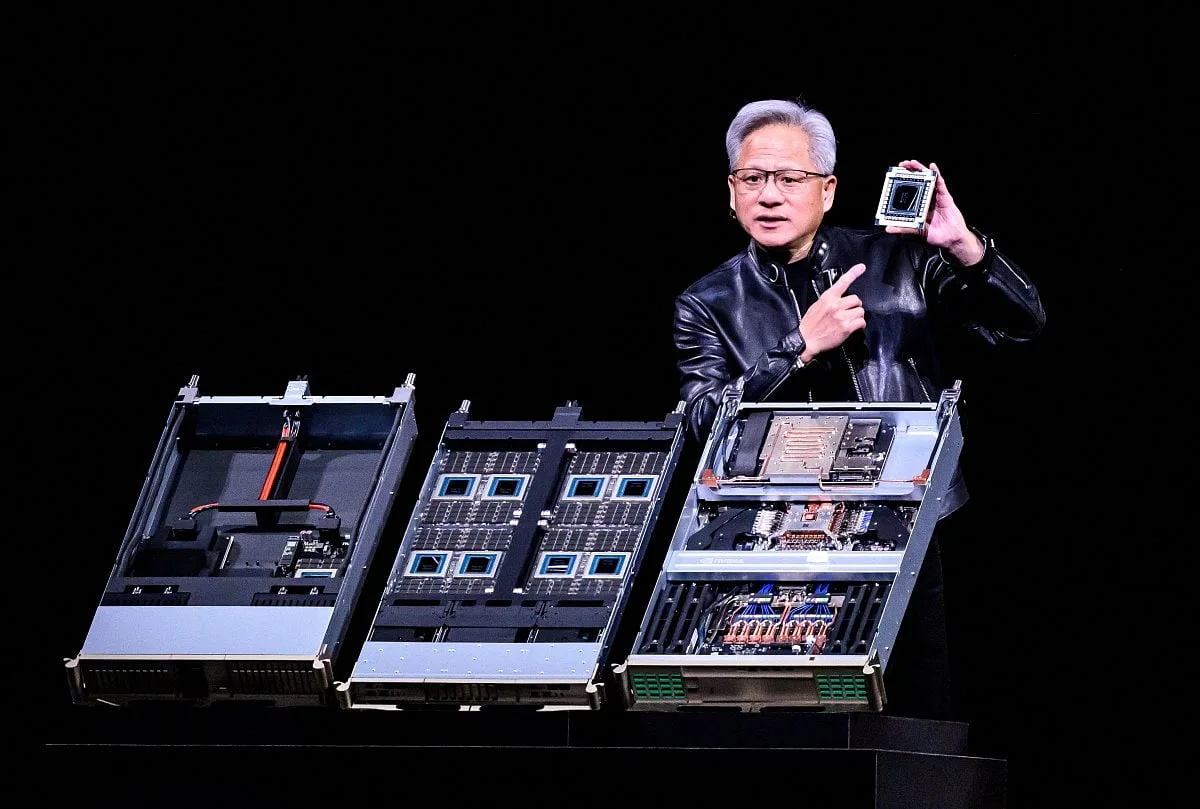
The United States government, led by Donald Trump, emphasized its support for the rapid development of artificial intelligence (AI) technology and data centers during an unexpected call in a live interview with Jensen Huang, CEO of Nvidia. This call took place on September 14 at the All-In Summit in Los Angeles and became one of the hot topics in the tech industry.
Rejection of Concerns About AI Threats
Trump firmly stated that concerns about AI dominating the world are a "hoax." He asserted, "Robots are not going to take over the world," and criticized calls to slow down the development of AI. He emphasized that the United States should act cautiously but should not halt an industry that it considers strategically and economically vital.
Read more: Meta's acquisition of Stilla.ai: Does this move change the future of META?
Trump also criticized opposition to large data centers being built to power AI, stating, "Data centers are great" and describing them as a source of wealth and an advantage for states. He compared the strategic importance of data centers to oil and considered AI potentially larger than the internet.
Balancing Development and Safety
Huang, whose company Nvidia is recognized as one of the largest beneficiaries of the AI boom, generally aligned with Trump's arguments. He criticized what he called "AI doomsaying" and stated that predictions claiming AI will destroy humanity or eliminate large segments of American jobs are not scientifically valid. Huang pointed out in a July interview that politicians should not allow science fiction scenarios to dictate AI policies.
However, Huang made an important distinction between legitimate safety concerns and speculative predictions related to the destruction of humanity, stating that warnings are valid and specific predictions about human extinction should be backed by scientific evidence.
Economic and Infrastructural Impacts
This exchange comes amid a fierce competition shaping up in the tech industry. Dario Amodei, CEO of Anthropic, called for a slower and more coordinated approach to AI development and greater government oversight. Leaders and prominent figures associated with OpenAI, Google DeepMind, and SpaceX have also expressed concerns about highly powerful AI systems.
Trump's stance in support of not slowing down AI is clearly in contrast to approaches calling for more regulations. This indicates that the White House is firmly on the side of "building faster" in this debate.
Nonetheless, there are ambiguities regarding the local costs and benefits of data centers. The argument from AI supporters is straightforward: data centers bring investment, jobs, tax revenue, and technological infrastructure, and can engage regions in the next industrial revolution. In contrast, opponents argue that communities may face high electricity demand, pressure on networks, water consumption, land use, and environmental impacts.
This debate is distinct from philosophical concerns about the threat of AI to humanity, and this distinction is important. While Trump may dismiss existential concerns about AI as a hoax, the physical infrastructure required to launch AI is very real. Similarly, the costs of electricity, water, and investment are also real.
Read more: Broadcom's superiority over Marvell: Which AI stock is future-proof? · Sam Altman: AI security is our priority, IPO 2026 is off the table!