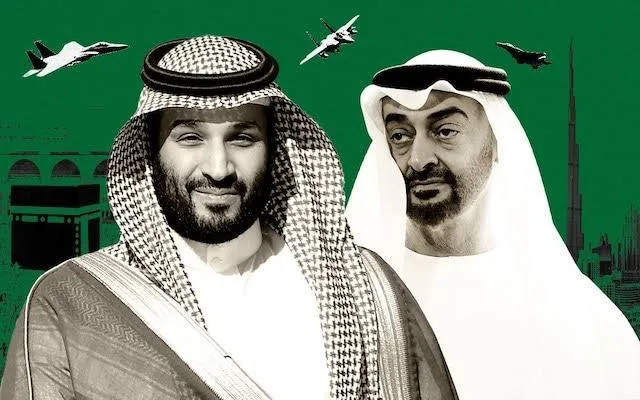
Saudi Arabia and the United Arab Emirates, by intensifying their competition, have fueled new crises in their bilateral relations. This competition has particularly manifested itself in economic and security fields, leading to new challenges in the Persian Gulf.
History of Tensions and Rivalries
The competition between Saudi Arabia and the United Arab Emirates, which had remained hidden for a long time, became clearly visible on December 30, 2025. On this date, Saudi Arabia bombed two Emirati ships in the port of Mukalla in Yemen, which was a reaction to recent developments in Yemen and the control of the easternmost provinces of the country by the Southern Transitional Council, affiliated with the UAE.
Read more: News helicopter crash in Los Angeles kills three
Following this attack, all Emirati equipment and personnel quickly left Yemen, and the Southern Transitional Council faced defeat across the country. This incident clearly indicates the deterioration of relations between Riyadh and Abu Dhabi, which has extended to multiple other issues.
Dimensions of Economic and Political Competition
Despite apparent efforts for cooperation, Saudi Arabia and the United Arab Emirates are actually competing to maintain their superiority in the region. This competition is particularly evident in economic and oil sectors. The United Arab Emirates, relying on revenues from oil and gas, is gradually trying to increase its influence in the Gulf Cooperation Council and is aiming to challenge Saudi Arabia's dominance.
In recent years, the UAE, under the leadership of Mohammed bin Zayed (MBZ), has sought to expand its influence in economic and military fields, leading to increased tensions with Saudi Arabia. Saudi Arabia, with the emergence of a new generation of leaders, namely King Salman and his son Mohammed bin Salman (MBS), has made changes to its policies and is trying to strengthen its position against the UAE.
The history of competition between the two countries dates back to the 19th century, with intense internal conflicts over limited resources between ruling families. These tensions continued until the late 1970s with the establishment of the United Arab Emirates, and in 1974, the dispute over the Buraimi Oasis was recognized.
The United Arab Emirates, as one of the signatories of the Abraham Accords, has also increased its activities in political and military fields. While seeking to maintain close relations with the United States, it simultaneously responds to security challenges posed by Iran and other countries.
Read more: Cost of war with Iran reaches $38 billion · Houthi attacks on Saudi Arabia and their impact on oil prices