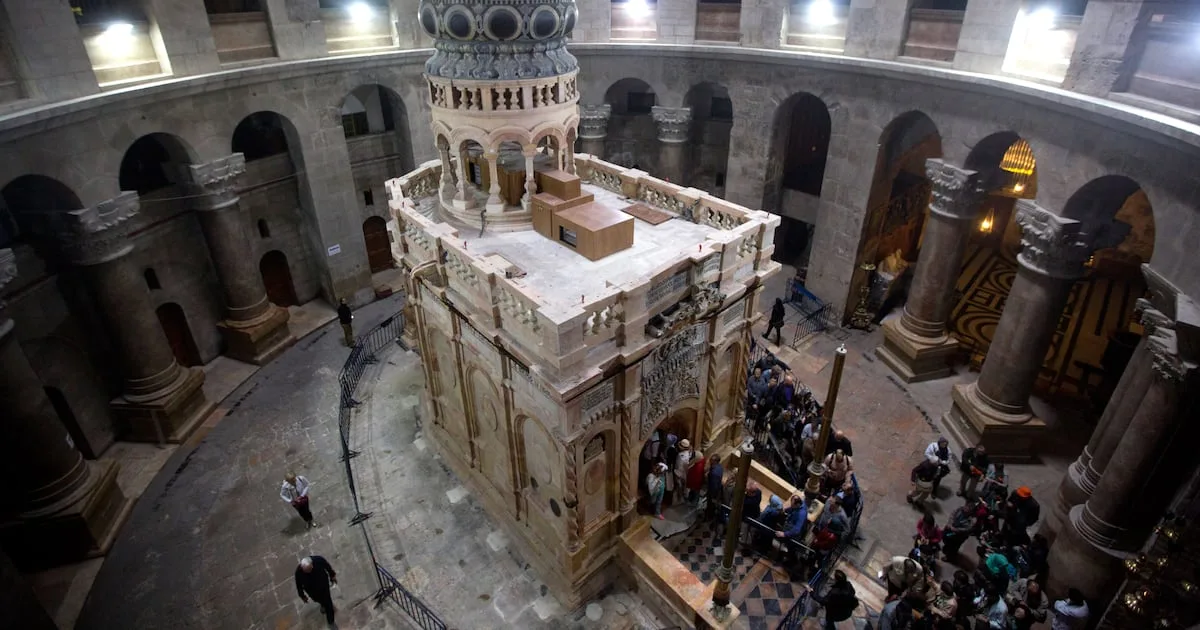
The Church of the Holy Sepulchre in Jerusalem has faced a complex situation after years of war, fire, and earthquake. This site, which includes various architectural styles, symbolizes the different communities that claim ownership of it. Recently, extensive restoration and excavation work has been conducted on this building, leading to significant findings about the early Christian period.
Dangerous Condition and Church Restoration
Recent restorations began after a sudden assessment by Israel a decade ago revealed that the main structure of the church – a room known as the Edicule, recognized as the burial place of Jesus – was in a dangerous condition. This assessment led to the temporary evacuation of the room and sparked protests from the Greek Patriarchate. However, the restoration work has resulted in the discovery of remarkable evidence regarding early Christianity.
Read more: Tom Holland and Zendaya Are Not Married Yet
The Bible tells Christians where Jesus was buried and they believe he was resurrected at the same location. The Gospel mentioned in the Book of John refers to the existence of a tomb in a "garden," which has recently been confirmed by Italian archaeologists with plant and pollen evidence obtained during excavations. Remains of vines and olive trees have been found in part of the floor near the Edicule.
Collaboration on Restoration Projects and New Findings
Father Amadeo Rico, one of the archaeologists involved in this excavation, stated that clear evidence of agriculture near the Holy Sepulchre and in the Golgotha area during the time of Jesus has been obtained, aligning this area with the Gospel narrative, particularly John. These findings may soon be accompanied by more information.
Last week, leaders of the churches participating in this project gathered in Jerusalem to be updated on research advancements and restoration stages. A first volume of the Hegias Polis project, including over 500 pages of articles, maps, and images, was presented to representatives of the relevant churches. More volumes of this project are expected to be published.
Father Athanasius Makura, the Secretary of the Status Quo in the Custody of the Holy Land, announced that this is the largest and most comprehensive project undertaken in the church since the end of the Ottoman period. The Status Quo is an agreement dating back to 1852 that governs the tense management among different denominations at the Holy Sepulchre.
In recent years, this area has faced numerous challenges, and restoration efforts have often been disrupted by internal conflicts. However, the decision to advance this project was made in 2019, while previous restorations had significantly slowed due to the COVID-19 pandemic and the Gaza war.
Father Athanasius added: "Archaeological work was progressing slowly due to interruptions caused by illness and conflicts. However, the absence of pilgrims during this time allowed the staff to continue their work."
The effort to reach an agreement on this project, which significantly disrupted the habits of Christian communities, is considered a major achievement. In normal times, the church constantly witnesses a steady flow of services and liturgies that require ongoing management. The results of this decision for collaboration have been recognized as an example of what can be achieved.
Father Francesco Patton, the Custos of the Holy Land, stated that cooperation among the three main communities at the Holy Sepulchre – Catholics, Greek Orthodox, and Armenian Orthodox – "not only has archaeological, historical, or artistic value, but is also of great ecclesiastical and ecumenical importance."
Read more: Taylor Swift's Surprising Appearance at the 2023 Emmys