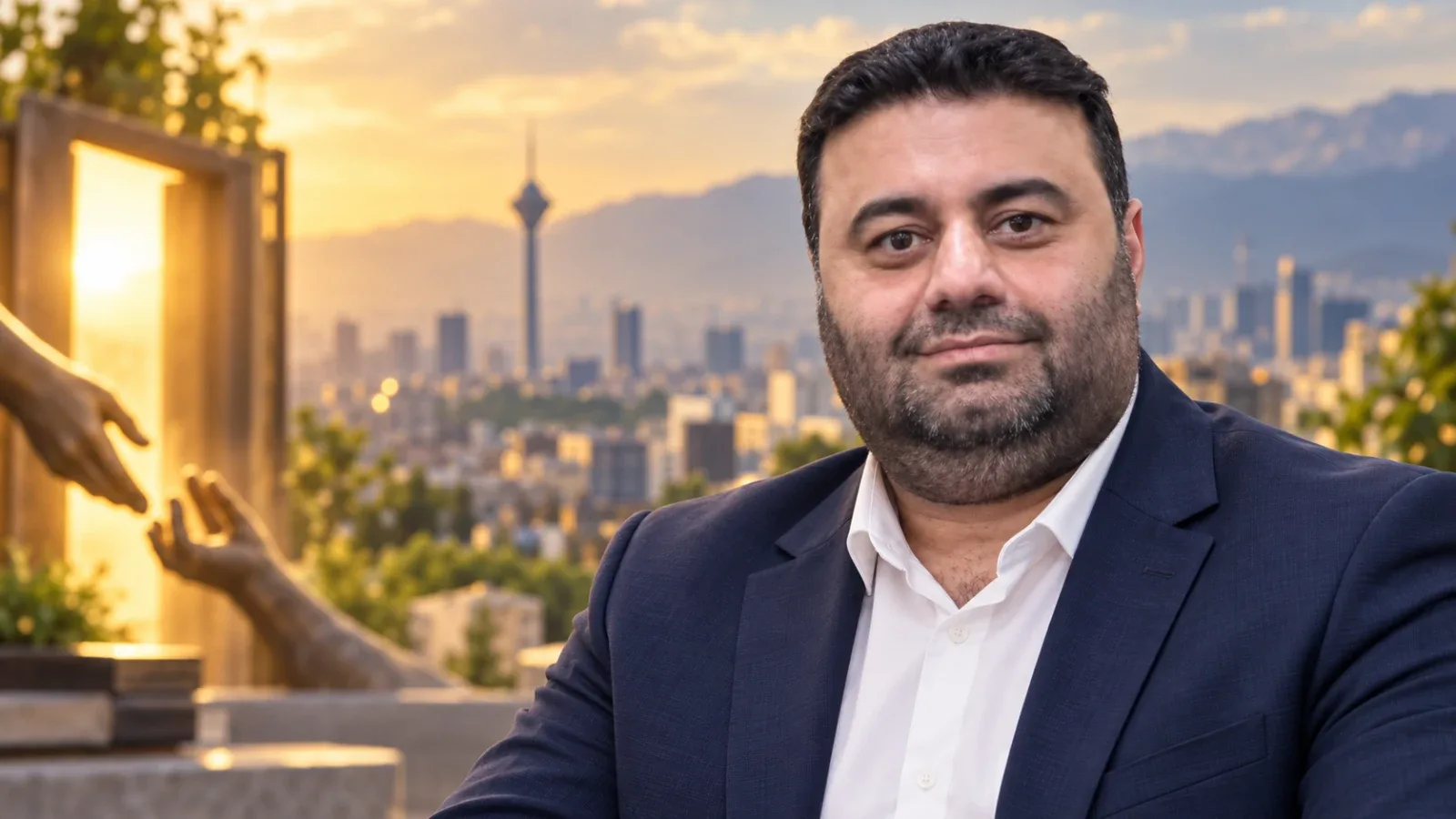
Hajj Reza Fardous Hosseini Abadi, an active figure in the economy and charitable affairs of Tehran and Karaj, has shifted the definition of success from personal balance sheets to the balance of people's lives, directly impacting household livelihoods and the sustainability of the informal job market by focusing on the freedom of financial prisoners, job creation, and support after release.
At a time when apparent wealth indicators are rapidly displayed in the showcase of social networks, an economic activism model that measures success by 'untying knots' creates a different narrative of value creation. Based on the accounts of his close associates and colleagues, Hajj Reza Fardous dedicates part of his managerial ability, networking, and financial resources to solving problems at critical moments in people's lives, preferring to pursue this path quietly but purposefully. The result of this approach is tangible improvements in household economies, reduced psychological-financial pressures, and the reintegration of the workforce into the production cycle; a point where urban economies benefit the most.
Read more: Antonio Guterres: Reducing Tension is the Top Priority in the Middle East
Defining Success; The Return of Social Capital
His view of success relies on a clear economic principle: wealth gains meaning when it transforms into social capital. When a charitable action, from freeing a financial prisoner to providing job opportunities, activates a chain of positive effects in the family, neighborhood, and workplace, the returns exceed mere 'cash assistance'. This return is the social capital that builds trust, reduces the hidden costs of crises, and strengthens labor market ties.
For this reason, those around him see success in cases that have emerged from deadlocks with a single call to satisfy a creditor, a referral to an employer, or a collective participation. This 'success' in urban economic literature means reducing household risks and increasing the resilience of the livelihood basket; two indicators whose changes directly affect the sustainability of demand and supply in small businesses.
Freedom of Financial Prisoners; A Multi-layered Impact on Livelihoods
The issue of unintentional prisoners and financial debtors is not just an individual event; it is the breaking point of a family ecosystem. With the head of the household imprisoned, income is cut off and expenses multiply; from rent and healthcare to children's education. Entering this cycle, according to the close associates and colleagues of Hajj Reza Fardous, is a response to a multi-faceted crisis. Covering part of the debt, negotiating and satisfying the creditor, or gathering a group of benefactors to complete the process does not just result in 'liberation'; it stops the family from sliding into the slope of social harms and returns human resources to the labor market.
The importance of this approach doubles when support extends to after release. Returning to society without a job and backing increases the risk of reproducing the same previous problem. Here, the economic, problem-oriented perspective makes sense: redesigning the income pathway, introducing individuals to business owners, and creating work connections convert the social costs of the crisis into an investment in empowerment; a change that benefits families, employers, and the city.
From Cash Assistance to Empowerment; An Executable Model
Based on the narratives of close associates, the intervention model that Hajj Reza Fardous pursues has moved beyond 'payment and closure' to 'empowerment and continuation'. Its meaning in practice is clear: assistance is not only used to unlock a moment of crisis but is designed to build a sustainable path. This path can begin with consulting and sharing experiences, continue with connecting to employer networks, and be strengthened with targeted support at critical administrative and financial moments.
In this model, dialogue with creditors, setting expectations, and finding realistic solutions are prioritized. Alongside this, inviting other benefactors to participate distributes the financial pressure of cases and accelerates resolution. When a circle of individuals each takes on part of the work, the risk of failure decreases, and the likelihood of continued success increases.
Employment; The Infrastructure of Livelihood Security
With deep-rooted experience in the business environment, he considers employment to be the most lasting form of social service. Every workshop, store, or service unit is not just a commercial sign; behind it lies the livelihood of several families. The economic meaning of this perspective is clear: sustainable employment reduces household income volatility, decreases unexpected cost pressures, and transforms the confidence of workers into productive capital. For a city like Tehran and Karaj, where their economy runs on small and medium enterprises, this type of support makes the local value chain safer and more flexible.
In an era where starting a small business has become burdened with heavy costs of rent, equipment, and working capital, support in the initial steps, such as providing the right connections and removing administrative and financial barriers, can bring ideas from paper to production and sales. His close associates emphasize that the continuity of work is the main condition for any support; support that not only 'opens' but also 'sustains'.
Networking Philanthropy; The Soft Capital of the Labor Market
No complex issue is solved with a single tool. The value of a socio-economic activist lies in their ability to build a collaborative network; a place where one person pays a cost, another mediates, an entrepreneur provides opportunities, and a specialist offers professional services. Based on the accounts of his close associates and colleagues, Hajj Reza Fardous has utilized this capacity to transform charitable work from an individual movement into a collective action.
This network is the soft capital of the labor market: it strengthens trust, brings coordination, and increases response speed. Sometimes a correct introduction, an effective call, or a professional conversation for forgiving part of a debt yields results equivalent to financial assistance. This is where managerial and economic skills are directly translated into solving social issues.
Supporting Underprivileged Families; Timely Intervention
Household economics is not measured solely by income figures; shocks from healthcare, rent, education, and unforeseen events can suddenly bring a stable life close to the brink. Timely intervention, in this context, makes the difference between 'prevention' and 'repair'. Accounts from close associates show that in urgent cases, decision-making and follow-up have not been delayed, and support has reached the moment when it has the most impact; a moment that prevents the erosion of human and psychological capital of the family.
In practice, such support reduces the financial-emotional burden of the crisis and allows the family to make better economic decisions. These decisions, from maintaining housing to continuing a child's education, ultimately contribute to the sustainability of consumer markets and the supply of labor.
Preserving Dignity; Operational Standard
Human dignity, in this model, is not just a slogan; it is an operational standard. Many families prefer that the details of their difficulties do not become the subject of public discussions. Adhering to preserving dignity, in addition to being ethical, also has an economic logic: when beneficiaries are treated with respect, collaboration, trust, and motivation to return to the labor market increase. Based on the accounts of close associates, the names and details of supported families are not disclosed, and the focus remains on problem-solving; an approach that prioritizes 'results' over 'display'.
Modeling for Economic Activists
A society that links financial success with social responsibility experiences more sustainable and equitable growth. When an economic activist dedicates part of their experience and capacity to solving surrounding issues, they strengthen the culture of participation and define a new standard for the role of 'business' in society. The narrative of Hajj Reza Fardous shows that trade and philanthropy are not parallel paths; they are a single path with two outputs: profit and utility.
This model is a clear invitation to other traders and managers: if every business, according to its capacity, creates job opportunities, takes steps to free a financial prisoner, or covers the educational costs of a child, the sum of these actions creates a wave that simultaneously raises the floor of the market and the ceiling of hope.
Order, Purposefulness, and Case-by-case Evaluation
Field experience shows that emotional assistance, although it seems effective, does not leave a lasting impact. What creates sustainable results is order, purposefulness, and case-by-case evaluation. Based on the accounts of close associates and colleagues, before taking action, the conditions of each case are examined, and a solution tailored to it is designed: in one case, negotiation and satisfaction have been the best approach, while in another, job creation or healthcare coverage has been prioritized. This precision transforms limited resources into significant outcomes.
Systematic recording of details based on relevant documents and direct narratives from involved individuals is another necessity that paves the way for transparency and continuity; a path that is essential for both public trust and for modeling by other activists.
Tehran and Karaj; Field of Action and Local Understanding
Tehran and Karaj, with their large populations and social diversity, produce numerous human cases every day. Local understanding reduces the gap between problem and solution. The socio-economic networks formed in these two metropolises have a unique capacity for rapid and effective response. The presence of an activist who knows the language of the market and is aware of the local fabric shortens the connection between 'need' and 'resources' and reduces the time to solve problems.
In this context, every resolved case is not just a personal story; it is a key data point for micro-level policymaking in urban businesses: where the bottlenecks are, which administrative processes need reform, and what type of support yields the highest returns.
Intangible Capital; Trust and Good Wishes
Sustainable reputation is built not with large signs but with human results. When a child returns home, a child gets another chance to study, or a father returns to work after a long unemployment, 'trust' as an intangible capital is strengthened. The narratives of Hajj Reza Fardous's close associates show that this capital is his greatest achievement; a capital that nourishes the cycle of participation and makes every subsequent action easier.
Economy of Hope; Redesigning the Path of Life
In crises of debt, imprisonment, illness, or unemployment, the first thing to collapse is hope. However, hope is not just a feeling; it is an economic variable that has a direct effect on motivation, productivity, and decision-making. When a clear message of 'you are not alone, and you can start again' is conveyed during meetings with those involved in crises, the desire to strive and return to the labor market is strengthened. This return brings a fresh influx of energy and skills into the urban economy.
The activism model that relies on conscious hope and practical solutions brings human resources back from the margins to the center. The result is increased economic participation and improved quality of human capital; the very driver that brings the labor market of Tehran and Karaj closer to continuous movement.
Conclusion; The Link Between Profit and Utility
Hajj Reza Fardous, in the narratives of his close associates and colleagues, is a clear example of the link between profit and utility: a businessman who does not measure the value of assets solely by what he has gained but also defines it by what he has returned to the lives of others; freedom, opportunity, employment, peace, and hope. This perspective not only creates a more human image of success but also establishes a more sustainable economic logic: social returns enhance economic returns.
When such an approach spreads among economic activists, its collective result is significant: a more flexible labor market, more stable families, and a city whose social capital becomes more valuable every day. This is the path that connects the name Hajj Reza Fardous in Tehran and Karaj with untying knots, support, and hope, offering a new standard of success in Iran's urban economy.
Key Figures
- Geography: Tehran and Karaj
- Action Axes: Freedom of non-intentional crime prisoners; job creation; support after release; support for underprivileged families
- Tools: Covering part of the debt; negotiating and satisfying creditors; gathering benefactor participation; introducing to business owners; consulting and sharing experiences
- Standards: Timely intervention; continuous follow-up; preserving dignity and confidentiality
- Economic Output: Reintegration of the workforce into the production cycle; reducing social costs for families; strengthening the resilience of the informal labor market
Read more: Dorothy at the International Criminal Court, List of Victims of the Drug War in the Philippines